
 Have you felt like your car was driving over the surface of the moon, but it was really only a flat street? That wobble, bounce, and shake is a big tip-off that your vehicle’s tires are unbalanced. Wheel balancing is part of routine maintenance, but sometimes, a tire imbalance happens suddenly – luckily, unbalanced tires are easily fixed.
What Is Wheel Balancing?
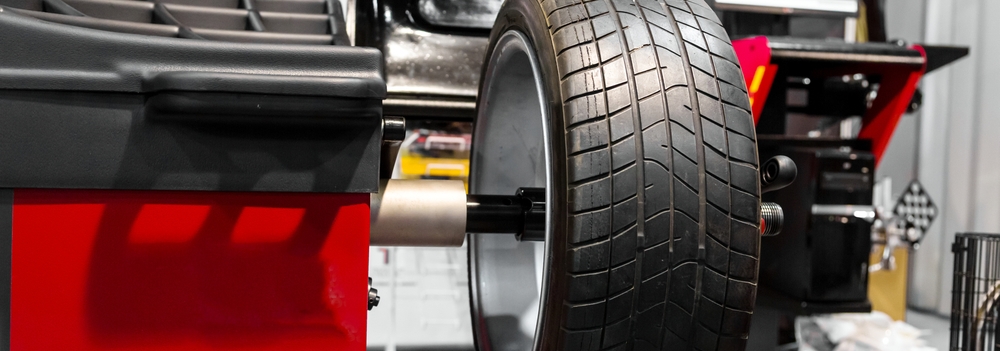
In general, manufacturers of rims and tires make their products with very minor imperfections. Wheel balancing corrects these slight weight distribution differences by adding small metal weights to the rim. When your vehicle has a tire imbalance, it can affect your safety and put stress on other components. Periodic wheel balancing keeps your car performing as designed, reducing wear and tear on complementary components. Read your owner’s manual for your vehicle’s factory-recommended wheel balancing schedule.
Types Of Wheel Balancing
Choosing the best method of wheel balancing for your vehicle can enhance your tires’ safety, performance, and longevity. Here’s a closer look at three common types of wheel balancing.
Static Balance = Simple
Static wheel balancing is a simple way to eliminate heavy spots that cause vibrations or uneven wear. Your service technician mounts your wheel onto the balancer stand and adds small weights to the rim until the wheel balances. This method ensures your wheel’s circumference is evenly weighted, with the heaviest part of the tire aligning with the lightest part of the rim. Static balancing is a quick and affordable process that’s also reliable for most passenger cars, SUVs, and light-duty trucks. Unfortunately, static balancing does not factor in the tire’s shape or sidewall stiffness.
Dynamic Balance = More Complex
Dynamic wheel balancing is a more complex method that calibrates the weight distribution of the tire and rim while factoring in the tire’s shape and stiffness. A machine spins the wheel and measures the rotational force variations. This sophisticated data determines the placement and number of small weights required to balance the wheel. Dynamic wheel balancing often results in a noticeably smoother ride than static balancing.
Road Force Balance = Advanced
Road force wheel balancing is an advanced balancing method that accounts for the weight distribution of the wheel and the amount of road force the tire generates as it rotates.
A special machine applies a load to the spinning wheel, simulating your vehicle’s weight on the tire. Then, it measures the tire’s vibration transfer and determines the exact weight placement needed to achieve perfect balance. This precise balancing method works well because even minor road vibrations can create ride discomfort. However, it can be more time-consuming and thus more expensive.
Correcting Tire Imbalance: Wobble & Bounce
Have you ever felt your tires bounce or wobble down the road? That tire imbalance sensation is called ‘tire runout‘ or ‘wheel runout.’ It refers to the shaking or vibrating as the not-quite-round tire rotates.
Below are two main types of wheel runout:
- Lateral Wheel Runout: The side-to-side tire wobble or deviation in rotation from a balanced circle.
- Radial Wheel Runout: The up-and-down tire bounce or deviation in rotation from a balanced circle.
The best way to repair an out-of-round tire is to schedule a road force balancing service.
What Causes Unbalanced Tires?
While everyday driving can contribute to unbalanced tires, a few additional factors can hasten the process. They include:
- Bumping curbs or parking blocks
- Damaged rim
- Faulty wheel bearings
- Foreign matter imbedded in tread (nails, screws, rocks)
- Improper tire mounting
- Manufacturing defects
- Parking or storing vehicles for extended periods (tires develop flat spots)
- Potholes
- Rough roads
- Tire damage
Safer Driving Through Routine Maintenance
Scheduling routine maintenance is one of the easiest ways to ensure safer driving. As a responsible motorist, one of your main goals should be ensuring your vehicle runs correctly and all its systems operate effectively. Not only does that goal protect the financial investment in your car, but it also helps protect others on the road. Vehicles with an up-to-date service record are less likely to break down or cause an accident due to faulty systems or part malfunctions.
Tire & Wheel Balancing Service
Fisher’s Auto Service provides a quality alternative to the quick-lube, chain-store tire shops, and dealership service departments. We offer the additional convenience, integrity, and personal attention of a locally-owned business in Kirkland, Washington. Our service technicians will quickly diagnose your tire imbalance to get you safely back on the road.
Make An Appointment
Call us at (425) 823-4441 or visit our website to schedule a wheel balance service. You can also stop by the shop and talk to our customer service reps. They will happily take care of all your automotive needs.
Fisher’s Auto Service, Inc.
11926 124th Ave NE
Kirkland, WA 98034